
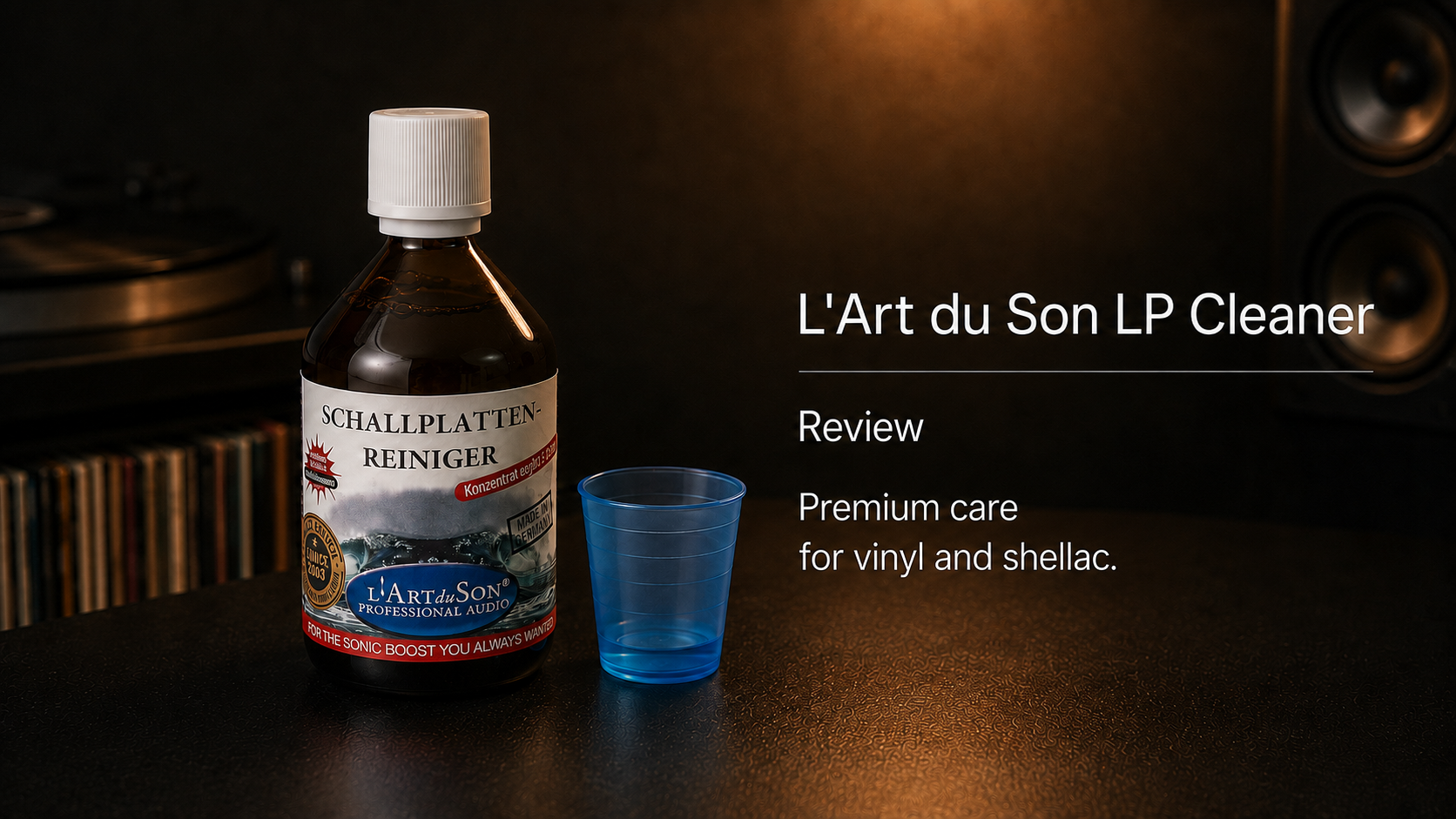
L'Art du Son LP Cleaner review – premium care for vinyl and shellac records
Introduction
A proper record-cleaning fluid should do more than remove visible dust. Grease, dried residues, traces of previous cleaning products and contaminants from the pressing process can settle deep inside the groove. These deposits may interfere with stylus movement, increasing surface noise and making playback sound less open and clearly defined. L'Art du Son LP Cleaner is designed to loosen these contaminants during wet cleaning so they can be removed with the liquid.
The product is supplied as a 100 ml concentrate and must be diluted with distilled or demineralised water. At the recommended ratio of 1:50, one bottle produces up to five litres of ready-to-use cleaning solution. Depending on the cleaning method and the amount applied, this is stated to be sufficient for approximately 500 records.
One of its most important characteristics is its alcohol-free composition. It can therefore be used on both vinyl and more sensitive shellac records. The formula also contains no emulsifiers or preservatives. This requires slightly more care when mixing and storing the solution, but it will appeal to collectors who prefer to avoid unnecessary additives.
Build quality and presentation
For a cleaning fluid, quality is reflected mainly in the packaging, dosing system and protection of the contents. L'Art du Son is supplied in a compact dark bottle that helps shield the concentrate from light. A small measuring cup is included, making it relatively easy to prepare the correct dilution.
The presentation is functional and aimed at serious record users. This is not a ready-to-use spray intended for a quick surface wipe. It is a concentrated maintenance product that needs to be mixed before use.
White particles or flakes may be visible in the concentrate. Suspended material may also appear in the diluted solution. According to the manufacturer, these particles are part of the product and do not automatically indicate deterioration. The bottle should therefore be shaken carefully before measuring. Excessive shaking is unnecessary and may create a considerable amount of foam.
Because the formula contains no preservatives, the diluted solution will age more quickly than some ready-mixed alternatives. Both the concentrate and prepared solution should be kept cool and protected from light. A coloured glass bottle is preferable to a clear plastic container for storing the mixture.
Ease of use and features
The recommended mixture is 20 ml of concentrate per litre of distilled or demineralised water. Smaller batches can be prepared at the same ratio, such as 5 ml of concentrate with 250 ml of water.
It is sensible to mix only as much fluid as is likely to be used within a reasonable period. This keeps the solution fresh and prevents a large quantity from remaining in storage unnecessarily.
L'Art du Son works best with a vacuum record-cleaning machine. Apply enough solution to wet the playing surface, spread it with a soft wet-cleaning brush and allow it to work in the grooves. The recommended contact time is generally between two and five minutes, although a shorter treatment can be sufficient for lightly contaminated records. Severely soiled records are better treated several times with fresh solution than washed once with an excessively strong mixture.
After the contact period, the fluid must be removed completely by vacuuming or rinsing. With a vacuum machine, two or no more than three drying rotations will usually be sufficient. Excessive vacuuming may cause the record to become statically charged again.
The cleaner can also be used in manual washing systems, record baths or with a microfibre cloth. When using these methods, a final rinse with clean distilled water is advisable. This helps remove both the suspended dirt and any remaining cleaning solution.
Storing or dispensing the mixture through a record-cleaning machine's internal fluid tank is less desirable. Such reservoirs can contain traces of previous products and may expose the solution to air, warmth and light. A separate application bottle is more hygienic and allows better control of the quantity applied.
A significant limitation is that L'Art du Son is not intended for ultrasonic record-cleaning machines. Its tendency to foam makes it unsuitable for the fluid circuits used in these systems and could interfere with their operation.
Sound quality, cleaning performance and user experience
A cleaning product cannot add musical information that is not present in the groove. Any audible improvement comes from reducing dirt, static charge and deposits that interfere with stylus movement. When the groove is cleaner, the stylus can trace the existing information more accurately.
On normally contaminated records, L'Art du Son can noticeably reduce surface noise. Small clicks and a steady background haze caused by dust or dried contamination may be reduced after a thorough treatment. Used records and discs that have been stored for a long time without suitable inner sleeves can benefit particularly strongly.
New records may also benefit from an initial wash. Paper dust, packaging debris and traces of the pressing process are not always visible. After cleaning, playback may sound calmer and more organised. Low-level information becomes easier to follow, while voices and instruments can emerge more clearly from the background.
Claims of improved dynamics and soundstage should nevertheless be interpreted realistically. The cleaner does not change the recording or alter the tonal balance of the audio system. It removes contaminants that may mask information. The difference can be substantial on a genuinely dirty record but more modest on a disc that has already been cleaned correctly.
The antistatic effect is useful as well. A properly treated record will usually attract fresh dust less quickly. The result will still depend on humidity, the inner sleeve, turntable mat, grounding and the design of the cleaning machine.
L'Art du Son cannot repair physical damage. Deep scratches, worn grooves, pressing defects and warping will remain. Very old records affected by mould, nicotine or heavily bonded organic contamination may require repeated treatments or a specialised enzyme-based pre-cleaner.
Comparison with similar products
Compared with ready-mixed record fluids, L'Art du Son requires more preparation. The user must dilute it, provide a suitable storage bottle and consider the natural ageing of the preservative-free mixture. In return, one small bottle makes up to five litres of cleaning solution, giving it relatively low running costs for anyone who washes records regularly.
Compared with many isopropyl-alcohol-based mixtures, it offers broader compatibility. It can be used on shellac records, for which alcohol must be avoided. A properly formulated alcohol-based cleaner is not automatically harmful to vinyl, but L'Art du Son remains an appealing option for users who specifically prefer an alcohol-free process.
Specialised enzyme cleaners may be more effective on severely contaminated records affected by mould, smoke residue or long-established organic deposits. Such products often require several stages and a separate rinse. L'Art du Son is easier to use as a versatile regular cleaner for new, second-hand and previously washed records.
Ultrasonic machines require a low-foaming product specifically approved by the equipment manufacturer. L'Art du Son should not be regarded as a universal replacement for a dedicated ultrasonic cleaning fluid.
Who is this product suitable for?
L'Art du Son LP Cleaner is particularly suitable for:
- collectors who regularly wash new and second-hand records;
- owners of vacuum record-cleaning machines;
- shellac collectors who require an alcohol-free fluid;
- demanding listeners who want to minimise dirt, noise and static charge;
- users who prefer an economical concentrate to repeated purchases of ready-mixed fluid.
A ready-to-use cleaner may be more convenient for someone who only cleans one or two records occasionally. Owners who exclusively use an ultrasonic machine will need a different product.
Advantages
- Alcohol-free and suitable for both vinyl and shellac
- 100 ml of concentrate makes up to five litres of cleaning solution
- Effective against dust, fingerprints and normal groove contamination
- Can reduce surface noise and static charge
- Suitable for vacuum machines and manual cleaning systems
- Economical for regular use
- Contains no emulsifiers or preservatives
- Measuring cup included
Disadvantages
- Must be diluted accurately before use
- Prepared solution requires cool, dark storage
- Large mixed batches are unsuitable for prolonged storage
- Not suitable for ultrasonic record-cleaning machines
- Manual cleaning benefits from an additional distilled-water rinse
- Cannot repair scratches, wear or pressing defects
- Severe contamination may require several treatments
Conclusion
L'Art du Son LP Cleaner is a carefully conceived and highly versatile maintenance product for serious record enthusiasts. Its alcohol-free formula, compatibility with vinyl and shellac and high dilution ratio make it attractive for extensive private collections and professional use.
The strongest results are achieved with a vacuum record-cleaning machine, a clean brush and sufficient contact time. When used correctly, it can effectively reduce contamination and static charge, allowing playback to become quieter, clearer and better differentiated.
It requires more discipline than a ready-to-use spray. The mixture must be measured correctly, stored in cool and dark conditions and kept out of ultrasonic cleaning systems. Users prepared to follow these instructions will receive an effective, economical and dependable record-cleaning fluid. It is especially recommendable for collectors who clean regularly and want a proven alcohol-free alternative.


