
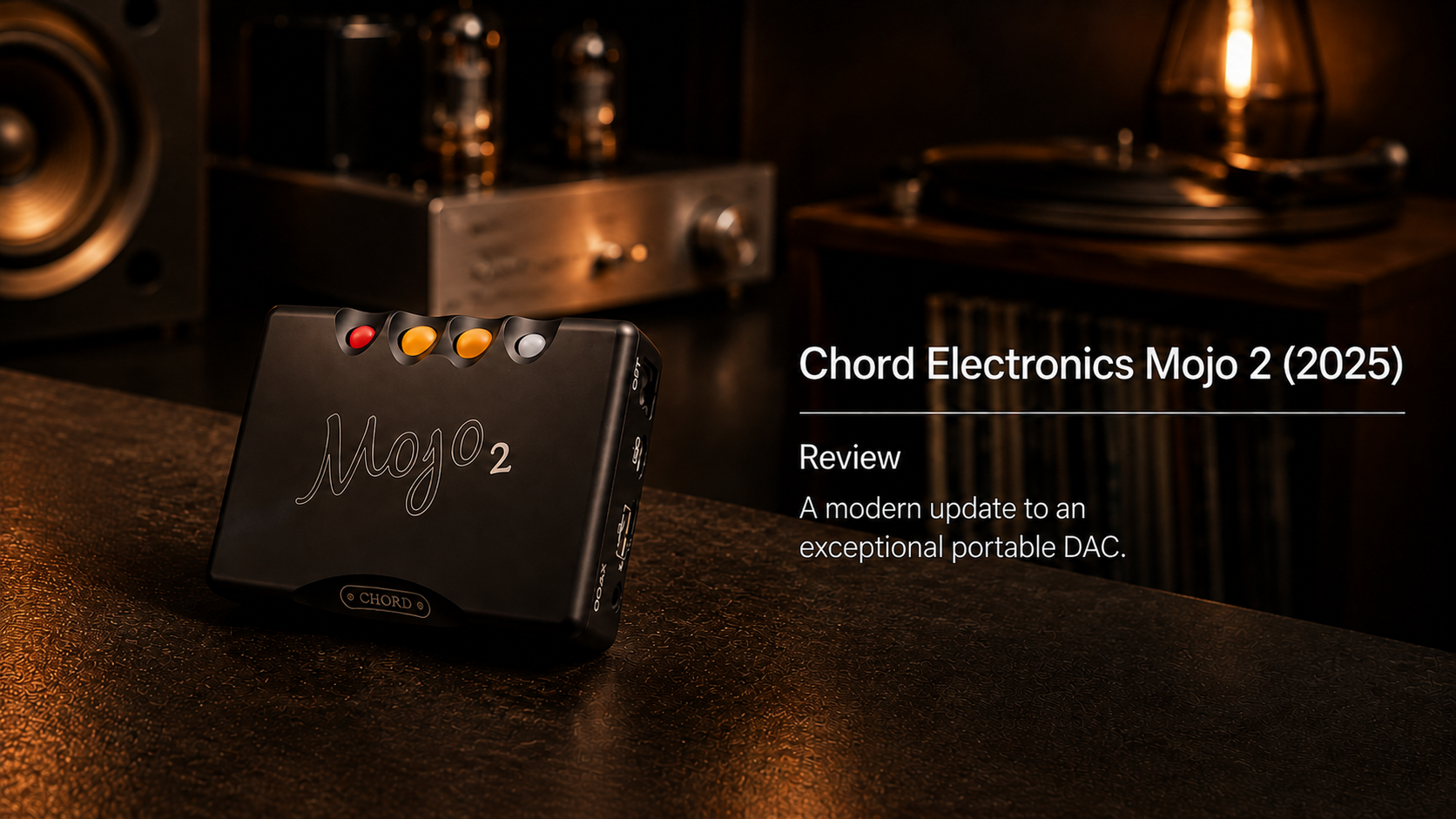
Chord Electronics Mojo 2 (2025) Review – a modern update to an exceptional portable DAC
Introduction
The Chord Electronics Mojo 2 has established itself as one of the most recognisable premium portable DAC/headphone amplifiers on the market. With the updated Mojo 2 (2025), Chord has wisely resisted the temptation to redesign a product simply for the sake of calling it new.
Instead, the company has addressed several practical limitations.
One of the original 3.5 mm headphone sockets has been replaced by a 4.4 mm headphone connection, while the USB-C input can now handle both audio data and battery charging. The 3.5 mm and 4.4 mm outputs also retain their own volume and DSP settings.
At Hi-Stands, we have now received the updated Mojo 2 and can supply it directly from stock.
Build quality and finish
The Mojo 2 remains unmistakably a Chord product.
Its compact enclosure is precision CNC-machined from aluminium in the UK and feels more substantial than the lightweight construction found on many portable DACs.
At roughly 83 x 62 x 23 mm, it is genuinely compact without trying to compete with tiny USB dongles.
Chord's illuminated spherical controls remain a defining feature. Colours indicate volume, sample rate and various menu functions.
It is clever and visually distinctive, but it also remains one of the Mojo 2's biggest usability compromises. Until the colour system becomes familiar, a conventional screen would unquestionably be easier to understand.
Usability and features
Connectivity is unusually comprehensive for such a small device.
Digital inputs include USB-C, Micro-USB, optical and coaxial, with support for PCM up to 32-bit/768 kHz and DSD up to DSD256 through suitable inputs.
The refreshed model provides:
- one 3.5 mm headphone output;
- one 4.4 mm headphone output.
There is an important distinction to make here. The presence of a 4.4 mm socket does not mean the Mojo 2 has suddenly become a fully balanced amplifier internally. Its analogue signal path remains single-ended.
The main advantage is therefore compatibility: headphones terminated with 4.4 mm plugs can now be connected directly without an adaptor.
We regard that as a sensible engineering decision rather than a weakness. Chord has not redesigned an already excellent amplifier simply to chase higher balanced-output specifications.
USB-C charging is arguably an even more useful update. Modern phones, tablets and laptops increasingly use USB-C, so eliminating the need to carry a dedicated Micro-USB charging cable makes everyday use considerably easier.
Independent volume and DSP memory for each headphone socket is another genuinely useful improvement.
UHD DSP and crossfeed
One feature that continues to distinguish the Mojo 2 is Chord's UHD DSP.
Rather than using a conventional analogue tone circuit, it allows the listener to make sophisticated digital tonal adjustments. This can be used to compensate gently for a headphone's tonal balance or simply to fine-tune playback to personal preference.
The Mojo 2 also includes several levels of crossfeed. Crossfeed subtly blends information between the left and right channels to reduce the extreme separation inherent in headphone listening.
The result can feel more natural and speaker-like, particularly during extended listening sessions.
Sound quality
Sound remains the main reason to consider the Mojo 2.
Its presentation is transparent, agile, controlled and highly resolving, yet it does not turn music into a cold technical exercise.
Microdynamic changes are reproduced exceptionally well. Instruments have convincing texture, vocals remain clearly defined and the Mojo 2 is particularly good at preserving timing and musical momentum.
Bass
Bass is deep, controlled and articulate rather than artificially enlarged.
There is excellent separation between individual bass notes, and the Mojo 2 is sufficiently disciplined to keep naturally warm headphones from becoming overly heavy.
Midrange
The midrange combines clarity with convincing tonal density.
Vocals are highly intelligible without becoming excessively forward, while acoustic instruments benefit from the Mojo 2's ability to reproduce fine texture and decay.
Treble
Treble is extended and revealing but generally refined.
Chord does not create an artificial impression of resolution by simply pushing the upper frequencies forward. Detail emerges naturally from a low-noise, highly resolving presentation.
Soundstage and imaging
Imaging is another major strength.
The Mojo 2 places instruments accurately and conveys front-to-back depth particularly well. It cannot manufacture a huge soundstage from a headphone that inherently sounds intimate, but it preserves spatial information extremely effectively.
Headphone driving capability
Chord specifies approximately 600 mW into 30 ohms and 90 mW into 300 ohms, combined with an exceptionally low output impedance of approximately 0.06 ohm.
That makes the Mojo 2 suitable for a very broad selection of headphones and sensitive IEMs.
Most dynamic headphones and many planar magnetic designs can be driven confidently. Nevertheless, an extremely inefficient headphone may still demonstrate greater authority and headroom from a powerful mains-powered desktop amplifier.
That limitation is simply a consequence of physics rather than a meaningful criticism of a battery-powered device this small.
Comparison with similar products
The iFi xDSD Gryphon, for example, takes a different approach. It provides integrated Bluetooth and a fully balanced 4.4 mm architecture, making it attractive to listeners who prioritise wireless connectivity and flexibility.
The Mojo 2 is more focused. Its emphasis lies on wired digital playback, proprietary FPGA conversion, sophisticated DSP and compactness.
Within Chord's own range, the Hugo 2 represents the logical step upwards. It offers broader connectivity and a more ambitious overall platform, but it is significantly larger and belongs to a considerably higher price category.
That gives the Mojo 2 a particularly compelling position: it delivers a substantial portion of Chord's digital design philosophy in a truly compact product.
Who is the Mojo 2 for?
The Mojo 2 is particularly suited to:
- owners of high-quality wired headphones or IEMs;
- smartphone, tablet, laptop and DAP users;
- listeners who value transparency and resolution;
- users wanting one DAC for both portable and desktop listening;
- audiophiles interested in DSP and crossfeed;
- owners of headphones terminated with 4.4 mm cables.
Users who regard Bluetooth, a large display or app control as essential may prefer a different type of product.
Pros
- Exceptionally transparent and detailed sound
- Excellent dynamics and timing
- Precise imaging
- Powerful amplification for its size
- Extremely low output impedance
- Sophisticated UHD DSP
- Adjustable crossfeed
- New 4.4 mm output
- USB-C data and charging
- Separate volume/DSP memory for each output
- Up to 768 kHz PCM and DSD256
- Excellent aluminium construction
- Suitable for portable and desktop use
- Chord Poly compatibility
Cons
- Colour-coded interface takes time to learn
- No display
- No built-in Bluetooth without Poly
- 4.4 mm socket does not represent a fully balanced internal design
- Around eight hours of battery life is no longer class-leading
- Extremely difficult headphones may benefit from a larger desktop amplifier
Conclusion
The Chord Electronics Mojo 2 (2025) demonstrates how to update a successful product without changing it unnecessarily.
The 4.4 mm socket, USB-C charging and independent output memories address genuine usability issues, while leaving the fundamental audio architecture intact.
That matters because sound quality remains the Mojo 2's greatest strength.
Its combination of transparency, resolution, rhythmic precision, dynamics and spatial insight remains exceptional for such a compact device.
It is neither the most conventional nor the most feature-heavy portable DAC on the market. Its interface requires some learning and users seeking wireless convenience have easier alternatives.
But for listeners who put sound quality first, the Mojo 2 remains one of the most convincing compact DAC/headphone amplifiers available.
The 2025 revision does not reinvent the Mojo 2. It simply makes an already outstanding product substantially easier to live with.


