
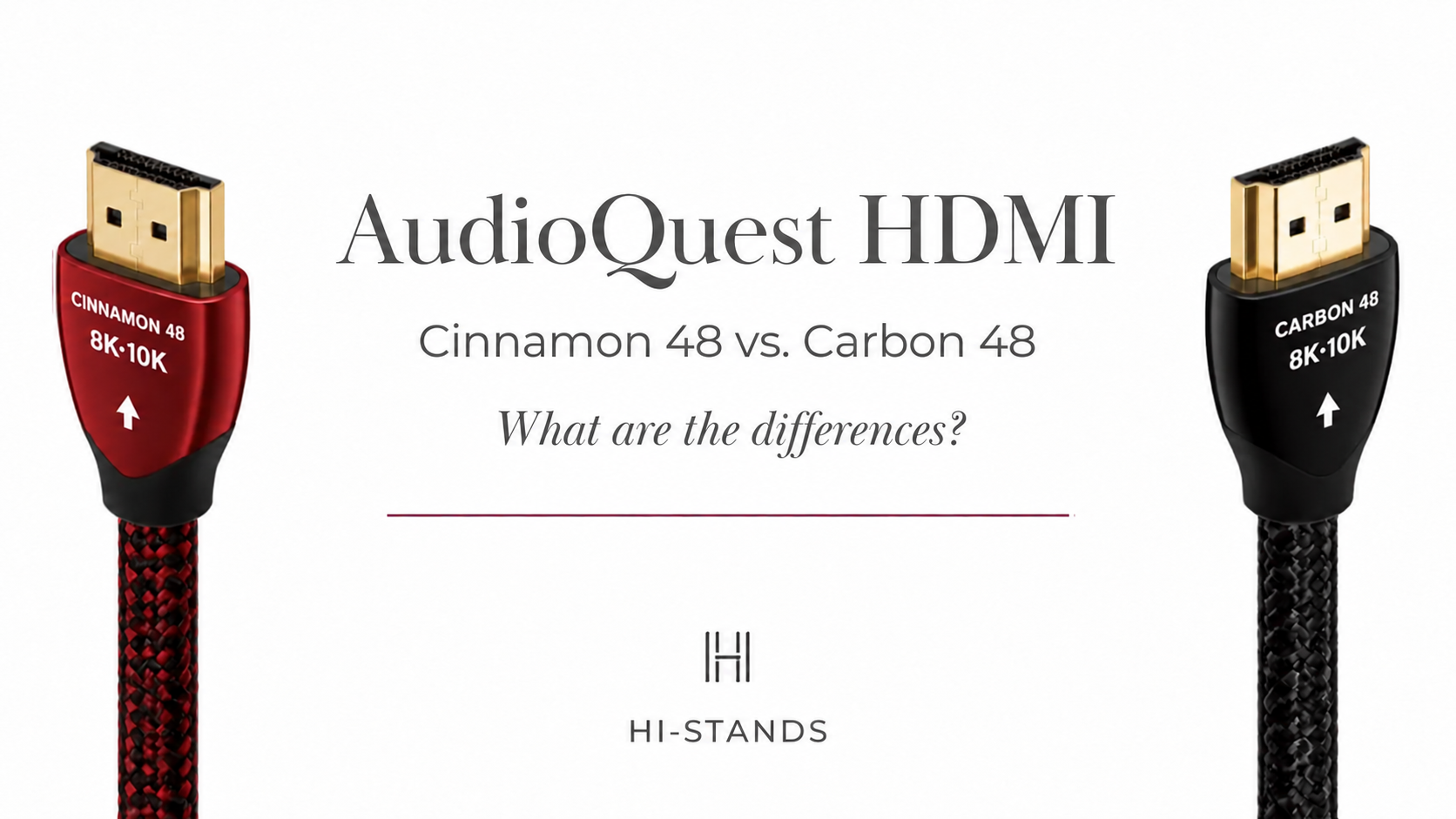
AudioQuest Cinnamon 48 HDMI versus AudioQuest Carbon 48 HDMI: what are the differences and which one suits you?
Two premium HDMI cables with the same 48 Gbps foundation
Anyone looking for a high quality HDMI cable for a modern television, projector, AV receiver, soundbar or game console will quickly encounter the AudioQuest Cinnamon 48 HDMI and AudioQuest Carbon 48 HDMI. Both models belong to the AudioQuest Ultra High Speed HDMI range and support bandwidth of up to 48 Gbps. This makes both suitable for applications including 4K at 120 frames per second and 8K at 60 frames per second, together with Dynamic HDR, eARC and gaming features such as VRR and ALLM when the connected equipment supports them. In terms of maximum HDMI bandwidth, Carbon 48 therefore does not provide a higher resolution or refresh rate than Cinnamon 48. The important differences are found primarily in the conductor materials and in the construction AudioQuest uses to manage unwanted radio frequency noise.
The main difference is the amount of silver
The clearest technical difference between AudioQuest Cinnamon 48 and AudioQuest Carbon 48 can be found in their conductors. Cinnamon 48 uses solid Long Grain Copper conductors with 1.25 percent silver plating. Carbon 48 also uses solid copper conductors, but increases the silver plating to 5 percent. AudioQuest applies silver to the conductor surface as part of its approach to improving high frequency performance and noise management. Carbon 48 therefore sits above Cinnamon 48 in the range when judged specifically by conductor material. This does not mean Carbon 48 can carry more HDMI data. Both products remain 48 Gbps cables. The additional investment in Carbon 48 is consequently directed toward the more elaborate conductor construction rather than an extra video format, additional HDMI bandwidth or a higher maximum refresh rate.
Noise dissipation and eARC matter on both models
Another important area when comparing AudioQuest Cinnamon 48 with Carbon 48 is radio frequency noise management. AudioQuest currently specifies Level 3 Noise Dissipation for both models. The construction includes a high loss carbon layer combined with metal around the four FRL and eARC pairs, while AudioQuest also states that all nineteen HDMI conductors are direction controlled to reduce radio frequency noise. Carbon 48 therefore does not gain a higher Noise Dissipation level than Cinnamon 48. Once again, the distinction is found in the conductor material. The dedicated eARC conductor pair in Cinnamon 48 uses 1.25 percent silver, while Carbon 48 uses 5 percent silver. For installations in which the HDMI connection is used extensively for eARC audio between a television and an AV receiver or soundbar, this is one of the most relevant construction differences between the two cables.
Will you actually see or hear a difference?
When considering a more expensive HDMI cable, it is useful to separate supported functionality from possible performance differences. If Cinnamon 48 and Carbon 48 both establish an error free digital connection within their specifications, Carbon 48 will not unlock an additional 4K120, 8K60, VRR or eARC feature that Cinnamon 48 cannot carry. AudioQuest positions its increased silver plating and noise management technologies as methods of reducing unwanted noise and distortion, particularly in high quality audio and video systems. Whether a difference becomes visible or audible in an individual system can depend on the connected equipment, cable length and electrical environment and should not be presented as guaranteed in every installation. The value of Carbon 48 therefore lies mainly in its more ambitious material specification rather than in access to additional HDMI formats. Ultra High Speed certification primarily confirms the required digital transmission capability.
When should you choose Cinnamon 48 and when should you choose Carbon 48?
For many premium televisions, game consoles and home cinema systems, AudioQuest Cinnamon 48 represents a very attractive choice. It provides certified 48 Gbps transmission, support for 4K120 and 8K60, eARC and a high quality construction using 1.25 percent silver together with Level 3 Noise Dissipation. Carbon 48 becomes particularly interesting when the rest of the system is also positioned at a higher level and you are prepared to invest more in its 5 percent silver conductors. A premium OLED television or projector combined with a high quality AV receiver and a capable loudspeaker system would be a logical environment in which to consider Carbon 48. If your main priority is a reliable connection for a PlayStation 5, Xbox Series X, media player or 4K television, Cinnamon 48 already provides a very strong technical foundation. Carbon 48 is primarily the choice for buyers who deliberately want the more advanced conductor material.
In 2026 the intended application remains more important than the model name
With HDMI 2.2 there is now an Ultra96 cable category supporting bandwidth up to 96 Gbps alongside the established Ultra High Speed HDMI category with up to 48 Gbps. This does not suddenly make Cinnamon 48 or Carbon 48 unsuitable. For equipment and video modes requiring no more than 48 Gbps, including many current 4K120 and 8K60 applications, both remain appropriate choices. If you are specifically building for a future application that genuinely requires more than 48 Gbps, however, neither Cinnamon 48 nor Carbon 48 is the correct cable category and Ultra96 should be considered. The decision between these two AudioQuest models therefore remains straightforward. Cinnamon 48 offers an excellent balance between premium construction and 48 Gbps capability, while Carbon 48 is intended for those who deliberately want to move to the more ambitious 5 percent silver conductor construction. At Hi Stands you can therefore select the HDMI cable that best matches both your equipment and your priorities.


