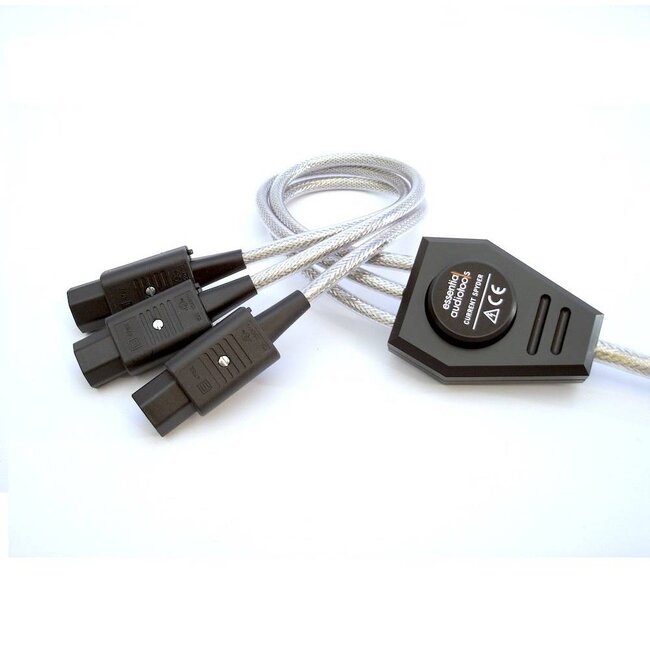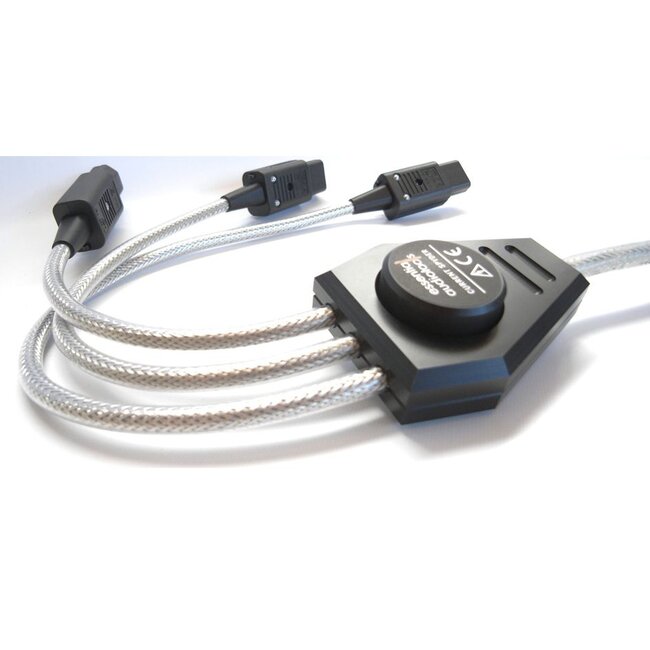
The idea is simple: A mains cable with a single mains plug and at the other end three cables, each with an IEC appliance plug. Read more.
Clever Thinking!
The idea is simple: A mains cable with a single mains plug and at the other end three cables, each with an IEC appliance plug.
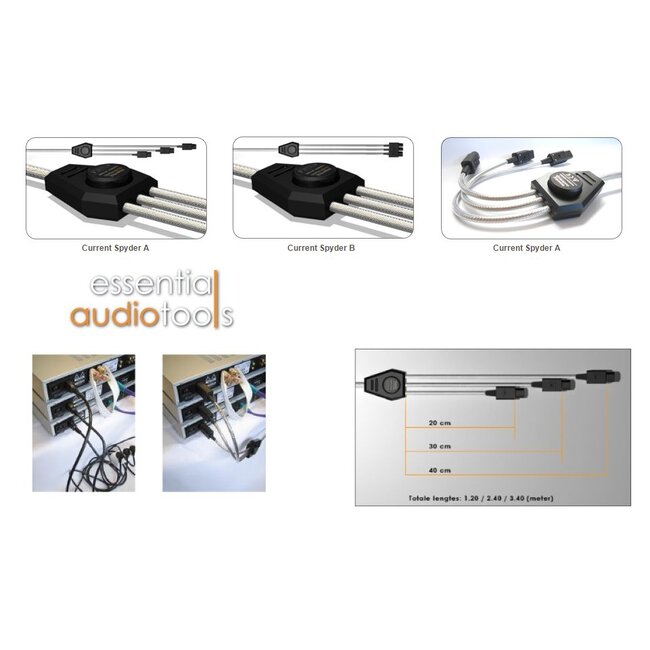
The three outgoing cables are 20, 30, and 40 centimeters long, so the Current Spyder hangs down when not in use and thus takes up minimal space. (It's also possible to get three cables with the same 40cm length.)
The result: Less clutter and cables behind the audio system, while maintaining performance.
In addition, the Current Spyder (with a y on purpose, because we like it that way) is equipped with an integrated Pulse Protector.
Here is a list of the possibilities:
Current Spyder A75 , primary 75cm, secondary 20, 30, 40cm
Current Spyder A150 , primary 150cm, secondary 20, 30, 40cm
Current Spyder B75 , primary 75cm, secondary three times 40cm
Current Spyder B150 , primary 150cm, secondary three times 40cm
Operating principle
Without us even realizing it, we find ourselves in a polluted environment. Fields created by current flowing through conductors are all around us. Interference pulses are also invisible to us, but they are certainly there. Every energy user causes fluctuations on the power grid in the form of pulses, or fluctuations in the field around us. The effects of these fluctuations can be detected in the space around the device and its power cord, as well as far away. This can only be detected with suitable measuring equipment, not with our ears.
There's a common belief that shielded power cables better protect the connected device from external influences, and that's true. However, it's far more important that the field from the power cable itself doesn't reach nearby interconnects. And it's precisely this last point that's often overlooked. Interconnects transport small signals to and from devices with high impedance, making them extremely sensitive to external fields.
Many audio power cables look great, just like ours. But appearances can be deceiving! The Current Conductor has a dual shielding. The outer shielding is NOT a braided steel jacket, as a steel jacket doesn't shield; it's intended to protect the cable from physical abuse. The Current Conductor has a copper shielding with a high-density braid and a tin-based oxidation protection layer. Furthermore, beneath the copper shielding is a 100% dense aluminum foil for high-frequency shielding. Unlike plastic foil, this solution actually works!
The three cores are robust enough to handle high currents without resistive losses (energy loss in the form of heat). The grounding conductor is connected at both ends, with shielding only on the power side, as is customary. Robust connectors ensure a secure connection to the mains and device contacts, and the mains plug features a housing made of special plastic.
Where to use?
The Current Spyder is a smart solution for connecting audio systems consisting of stacked devices (e.g. DVD player, tuner, amplifier) that are in plain sight.
Not only does the audio system's performance improve, but your relationship with your partner also improves dramatically! Finally, a product your partner will be happy to give you as a gift; perhaps you can even come up with the perfect occasion yourself.
Mains cables running near interconnects, especially if the inputs and outputs are unbalanced, can also make a significant difference. When mains cables run parallel to signal cables, or when the signal cables are part of, for example, the input or output of a phono stage, replacing the current conductor is highly recommended.
What to expect?
The results of experimenting with power cables can vary from small to very large. The most commonly reported improvements are a reduction in interference and hum levels, as well as an increase in "quietness" in the sound.

Find the order you'd like to withdraw
Enter your email address and order number.
Check your mailbox
If your details match an order, you'll receive an email with a link to view and manage it.