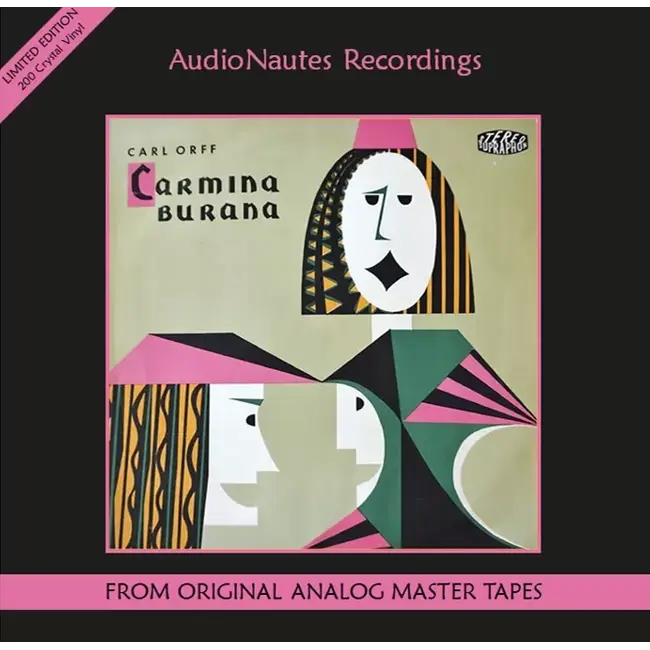
180g Vinyl, LP - AN-2512 Read more.
1. O Fortuna
2. Fortune Plango Vulnera Primo Vere
3. Veris Leta Facies
4. Omnia Sol Temperat
5. Ecce Gratum Uf Dem Anger
6. Dance
7. Floret Silva Nobilis
8. Chramer, Gip Die Varwe Mir
9. Round Dance
10. Were Diu Werlt Alle Min In Taberna
11. Estuans Interius
12. Olim Lacus Colueram
13. Ego Sum Abbas
14. In Taberna Quando Sumus Cour D’Amours
15. Amor Volat Undique
16. Dies, Nox Et Omnia
17. Stetit Puella
18. Circa Mea Pectora
19. Si Puer Cum Puellula
20. Veni, Veni, Venias
21. In Trutina
22. Tempus Est Locundum
23. Dulcissime Blanziflor Et Helena
24. Ave Formosissima Fortuna Imperatrix Mundi
25. O Fortuna
Carl Orff’s work from 1935 and 1936, which the composer himself described neither as an opera, an oratorio, nor a cantata, comprises 24 texts in Latin, Middle High German, and Old French. To this day, “Carmina Burana”, which premiered on June 8, 1937, at the Frankfurt Opera, continues to enjoy immense popularity. The musical setting of this work – centered primarily on secular themes such as fortune and prosperity, the transience of life, and the dangers of indulgence in drinking, gluttony, gambling, and lust – represents a completely new composition driven by Orff’s distinctive rhythmic vision.
“Carmina Burana” quickly became one of the most popular works of classical music and remains the most frequently performed choral/orchestral composition of the 20th century, with approximately 20 performances worldwide each month. In particular, the powerful choral movement CB 17 (“O Fortuna”), which opens the work, has achieved such fame that it is frequently used in advertising and film soundtracks – most often in the recording by the Atlanta Symphony Orchestra conducted by Robert Shaw. Although Orff authorized only the reduced version for soloists, large mixed choir, children’s choir, two pianos, and percussion prepared by his student Wilhelm Killmayer, connoisseurs regard the recording with the Czech Philharmonic under Václav Smetáček as especially outstanding. The Czech conductor, composer, and oboist succeeded in revealing the refined simplicity and emotional force of the melodies with remarkable clarity.
AudioNautes Recordings now presents the sonically impressive reissue of the 1961 Supraphon pressing – the first commercial stereo version of “Carmina Burana”, recorded using four RCA-DX77 microphones and a Telefunken M10 tape recorder. Carefully mastered from the original analog tapes, the LP has been pressed at Vinyl de Paris on transparent 180-gram vinyl and cut at 33 RPM. Experience “Carmina Burana” in unprecedented sound quality – and act quickly: this limited edition of 1,000 copies is certain to sell out soon.
• Conductor: Václav Smetáček
• Orchestra: Czech Philharmonic
• Choir Director: Josef Veselka
• Choir: Czech Singers’ Choir
• Tenor: Jaroslav Tománek
• Baritone: Teodor Šrubař
• Soprano: Milada Šubrtová

Find the order you'd like to withdraw
Enter your email address and order number.
Check your mailbox
If your details match an order, you'll receive an email with a link to view and manage it.