
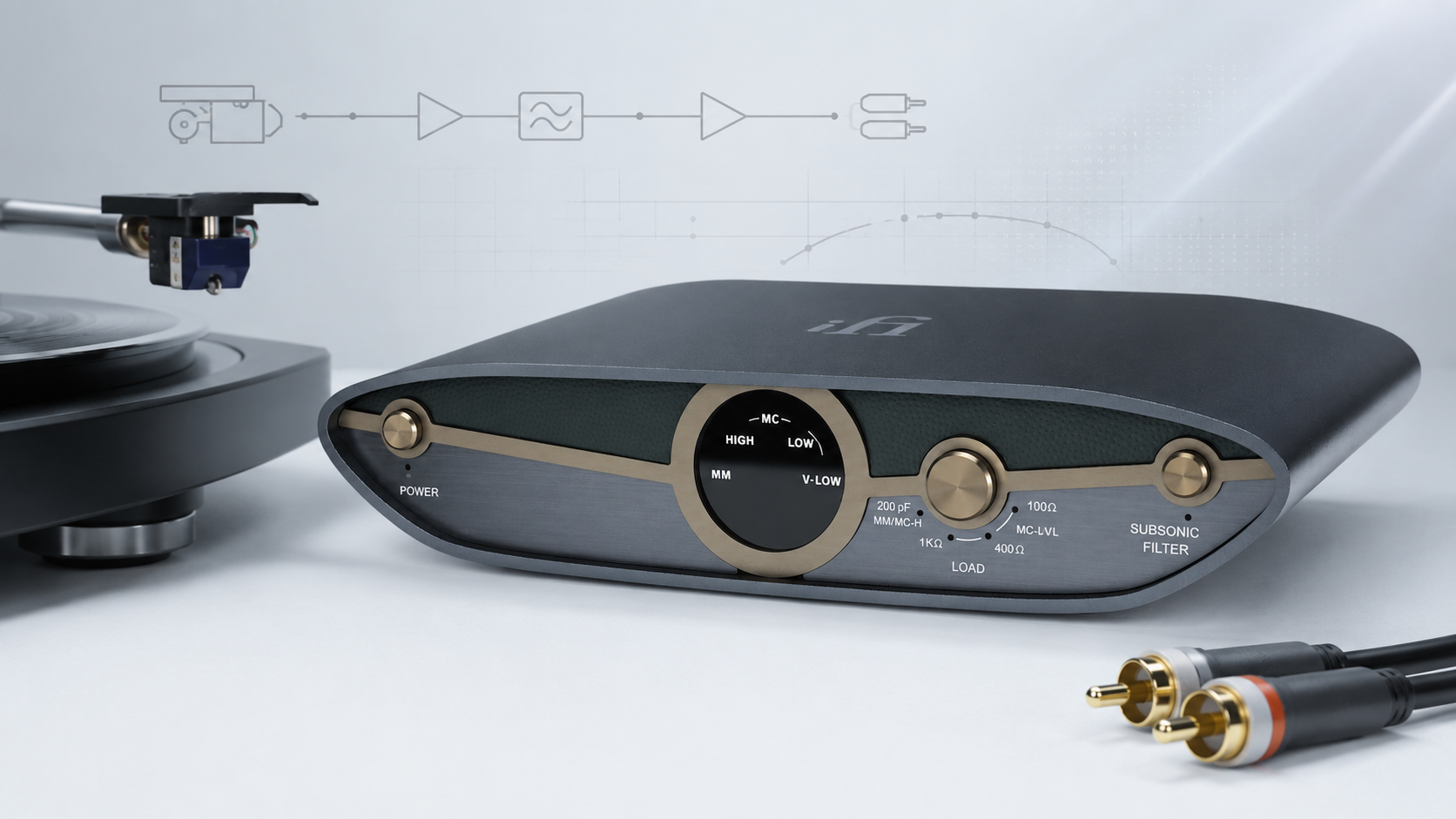
Optimise your analogue chain: the importance of the right phono preamplifier
A turntable, tonearm and cartridge may be carefully matched, but without a suitable phono preamplifier their full potential may never reach the rest of the system. The electrical signal generated by a cartridge is considerably weaker than the output from a streamer, CD player or another line level source. A turntable therefore cannot simply be connected to every ordinary amplifier input. The phono preamplifier provides the essential link between the cartridge and the main amplifier. Choosing the right phono preamplifier for a turntable creates the correct operating level, restores the intended frequency balance and helps every part of the analogue chain work together as a coherent system.
What does a phono preamplifier actually do?
A phono preamplifier performs two essential tasks. First, it amplifies the extremely small cartridge signal to a level that a normal line input can process. It also applies RIAA equalisation. During record production, low frequencies are reduced and high frequencies are increased. This allows the groove to be used more efficiently and supports practical record production and playback. During listening, the phono preamplifier applies the opposite correction and restores the intended frequency relationship. Without this process, a record would sound thin, bright and unnatural. Accurate RIAA equalisation is therefore just as important as having enough gain, because both functions directly influence the final balance and credibility of the reproduction.
Match the phono preamplifier to MM or MC
Before selecting a phono preamplifier, identify the type of cartridge fitted to your turntable. A Moving Magnet cartridge normally produces a comparatively high output and is often designed for an input resistance of 47 kΩ. Many Moving Coil cartridges generate a much smaller signal and consequently require more gain and a different input load. High output Moving Coil cartridges also exist, and certain models can be used with a suitable MM input. The letters MC alone therefore do not determine the correct setting. Always check the output voltage, internal impedance and recommended load of the exact cartridge before connecting it or changing the controls on the phono preamplifier.
A dedicated MM phono preamplifier can be an excellent solution when you do not expect to change to a low output MC cartridge. When you want to compare cartridges or expand the turntable in the future, a model with separate MM and MC modes offers greater flexibility. More advanced units may also allow gain, resistance and capacitance to be adjusted. This makes it possible to follow the cartridge manufacturer’s recommendations much more closely. Available gain settings can range from roughly 36 dB for MM cartridges to 72 dB for particularly low output MC designs, illustrating why a single fixed setting cannot provide an ideal match for every cartridge on the market.
Correct gain protects dynamics and headroom
When gain is too low, the volume control on the main amplifier must be turned much further than usual. Existing noise may then become more noticeable and the system can sound less assured. Excessive gain is not desirable either. It can create an unnecessarily high output level, leaving the following input stage with less room for strong musical peaks. A sensible approach is to use the lowest gain setting that provides a normal and satisfying playback level without requiring an extreme position on the volume control. When choosing a phono preamplifier, do not consider the MM or MC label in isolation. Compare the cartridge output voltage with the available gain values and follow the relevant manufacturer guidance.
A record does not have to sound equally loud as a modern digital source at exactly the same volume setting. Differences in mastering, dynamic range and average recorded level can mean that vinyl requires a higher position on the control. This does not automatically indicate an incorrect phono setting. Listen instead for natural dynamics, low background noise during quiet passages and clean reproduction when the music becomes powerful. When the presentation sounds hard and compressed, or the volume is excessive at a very low control position, a lower gain setting may be appropriate. When playback is unusually quiet and noise becomes intrusive, the next available gain level may provide a better match.
Input resistance and capacitance complete the match
Input resistance and capacitance help determine the electrical load seen by the cartridge. Many MM cartridges are designed for an input resistance of 47 kΩ, although the recommended capacitance differs between models. The phono preamplifier is not the only part that contributes to this value. The cable between the turntable and the preamplifier also adds capacitance to the total load. An unsuitable combination can influence the frequency response, making the upper frequencies sound too prominent or too restrained. Check the cartridge specifications and consider both the input capacitance of the phono stage and the properties of the cable before deciding that a tonal difference must be caused by another component.
Correct resistive loading is also important for a low output Moving Coil cartridge. Some models are intended to operate around 100 Ω, while others require a higher or lower value. There is no universal MC setting that is optimal for every design. Flexible phono preamplifiers may therefore provide a selection of values, such as a range from 70 Ω to 400 Ω or several fixed positions. Begin with the cartridge manufacturer’s recommendation and compare alternatives carefully only when the equipment allows it. Switch the system off before changing rear panel controls whenever the manual requires this, and avoid large random adjustments that are not supported by the technical information for the cartridge.
Reduce hum, noise and avoidable signal loss
Because the cartridge signal is so small, the connection can be vulnerable to hum and electromagnetic interference. Connect the turntable ground wire to the ground terminal on the phono preamplifier when the turntable provides one. Keep the cable between the turntable and preamplifier reasonably short and avoid positioning the phono stage directly on top of a large transformer, power supply or another possible source of interference. Confirm that all plugs are firmly seated and that the cartridge connections are clean and securely attached. A quiet analogue chain is not created by one magical accessory. It results from compatible equipment, correct grounding, suitable cables and thoughtful positioning.
A small amount of background noise may be normal in a high gain phono circuit, particularly when listening close to the loudspeakers while no music is playing. Clear hum, crackling or interference that remains obvious from the normal listening position usually suggests a connection problem, a ground loop, a damaged cable or unsuitable equipment placement. Change one factor at a time. Move the phono preamplifier first, inspect the grounding arrangement next and then test another appropriate cable when necessary. This systematic approach makes the actual cause easier to identify and prevents an unnecessary component purchase based on an incorrect diagnosis.
Built in or separate phono preamplifier?
Many amplifiers and some turntables include a built in phono stage. This is convenient and may be entirely adequate for a straightforward system. Always confirm that the input is compatible with the cartridge, because an integrated MM input cannot automatically support a very low output MC cartridge. A separate phono preamplifier becomes attractive when you need additional settings, want greater freedom in positioning or require more precise electrical matching. Its advantage is not simply that it occupies a separate enclosure. The real benefit is the ability to select suitable gain and loading values for the cartridge rather than accepting a fixed configuration that may have been designed for general use.
Price alone should never determine the choice. An expensive phono preamplifier that does not suit the cartridge output and recommended load may be less convincing than a more affordable model with the correct technical match. Begin by mapping the entire analogue chain. Record the cartridge type, output voltage, recommended load and the inputs available on the main amplifier. Consider future plans as well. When a transition from MM to MC is likely, a model with adjustable gain and loading may be the more sensible long term purchase, even when not every setting is required on the day it is installed.
Discover more music in every record
Choosing the right phono preamplifier for a turntable involves much more than increasing volume. Successful matching brings together gain, RIAA equalisation, input resistance, capacitance, noise performance and practical connectivity. When these characteristics suit the cartridge, the system can present music with greater calm, a more stable stereo image and a more natural overall balance. Begin with the cartridge specifications and compare them carefully with the capabilities of the phono preamplifier. At Hi Stands, you can explore solutions for a wide variety of analogue systems and select a model that supports both your current turntable and the upgrades you may consider in the future.


