
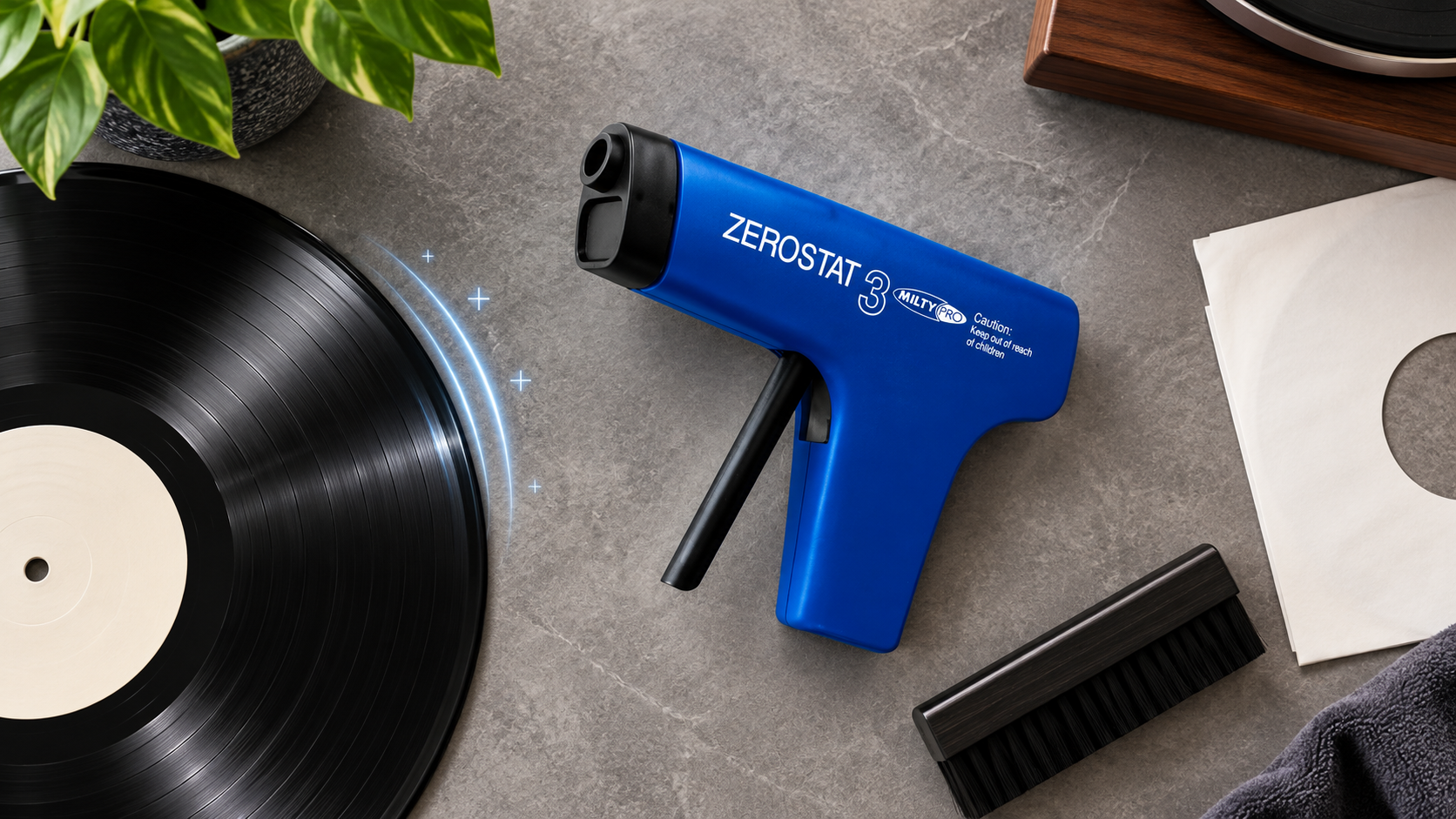
Milty Zerostat 3: reducing static electricity on vinyl records
A vinyl record that attracts dust, clings to its inner sleeve or produces occasional crackling sounds may be carrying a static electrical charge. Static is particularly common in dry environments.
The Milty Zerostat 3 provides a simple way to reduce this electrostatic charge without using liquids, batteries or mains power.
For many years, the Zerostat has been a familiar record-care accessory among vinyl collectors and works well alongside record brushes, cleaning machines and high-quality inner sleeves.
Why do vinyl records become statically charged?
Friction can be generated while playing, cleaning or handling a record, as well as when removing it from an inner sleeve. This can cause an electrical charge to accumulate on the vinyl surface.
Low humidity can make the effect even more noticeable.
A statically charged record can attract dust, hairs and other small particles more easily. This means that even a carefully cleaned record may quickly attract fresh dust.
Static electricity is not the same as dirt. A record brush or cleaning machine removes physical contamination, while an antistatic treatment specifically addresses electrical charge.
How does the Milty Zerostat 3 work?
The Milty Zerostat 3 uses a piezoelectric mechanism, which means that batteries and an external power supply are not required.
Slowly squeezing the trigger produces positive ions. Slowly releasing the trigger subsequently produces negative ions.
Together, these ions help neutralise electrostatic charge on the surface of the record.
No liquid has to be applied to the vinyl and the Zerostat does not need to touch the record.
How to use the Milty Zerostat 3 correctly
Correct technique is important when using the Zerostat. The trigger should not be pulled quickly like that of a conventional pistol.
Hold the Zerostat approximately 30 centimetres away from the record and point its opening towards the vinyl surface.
Slowly and steadily squeeze the trigger all the way in. Then allow it to return equally slowly to its original position.
Positive ions are produced while squeezing and negative ions while releasing.
You can repeat the process at several positions around the record to reduce static charge across a larger area.
There is no need for the device to make physical contact with the vinyl.
When should you use a Zerostat 3?
The Milty Zerostat 3 can be useful:
- before playing a record;
- before using a record brush;
- after removing an LP from its inner sleeve;
- after cleaning a record;
- whenever a record noticeably attracts dust;
- in rooms with particularly dry air.
Static electricity can be especially noticeable during colder months when indoor humidity is often lower.
Antistatic treatment before brushing?
If a record is heavily charged, it can be useful to reduce the static charge first and then remove loose particles with a suitable record brush.
With less electrostatic attraction, loose dust may be easier to remove.
Fingerprints, grease and other physical contamination still require proper cleaning. The Zerostat 3 is therefore not a substitute for a record-cleaning machine or suitable cleaning solution.
No batteries, liquids or refills
One of the major practical advantages of the Zerostat 3 is its simplicity.
It requires no batteries, cables, cleaning fluids or consumable refills and can therefore remain ready to use beside your turntable.
Part of a complete vinyl-care routine
Proper record care generally consists of several different steps.
Record-cleaning machines and cleaning solutions remove actual contamination. Record brushes remove loose dust, while good antistatic inner sleeves can help protect records while they are stored.
The Milty Zerostat 3 complements these accessories by specifically addressing electrostatic charge.
For collectors who want to care for their vinyl collection thoroughly and minimise the attraction of dust, the Zerostat 3 is an extremely practical accessory.
Safe use
Do not touch the opening at the front of the Zerostat while operating it. The device should also not be used near flammable gases or highly combustible materials.
During normal use, the Zerostat never needs to touch the record.


