Bluetooth versions and terms explained clearly
Bluetooth is now much more than a convenient way to connect headphones, speakers, streamers or receivers without cables. Behind one small Bluetooth logo are different generations, radio technologies, audio profiles and codecs that together decide what a product can actually do in daily use. The first misunderstanding to remove is simple. A higher version number does not automatically mean better sound. The Bluetooth Core Specification defines the technical foundation for Bluetooth Classic and Bluetooth LE, but a device does not have to support every feature available in that version. That is why it is always wiser to look at the real product features, such as LE Audio, Auracast, aptX, LDAC, multipoint or a stated operating range.
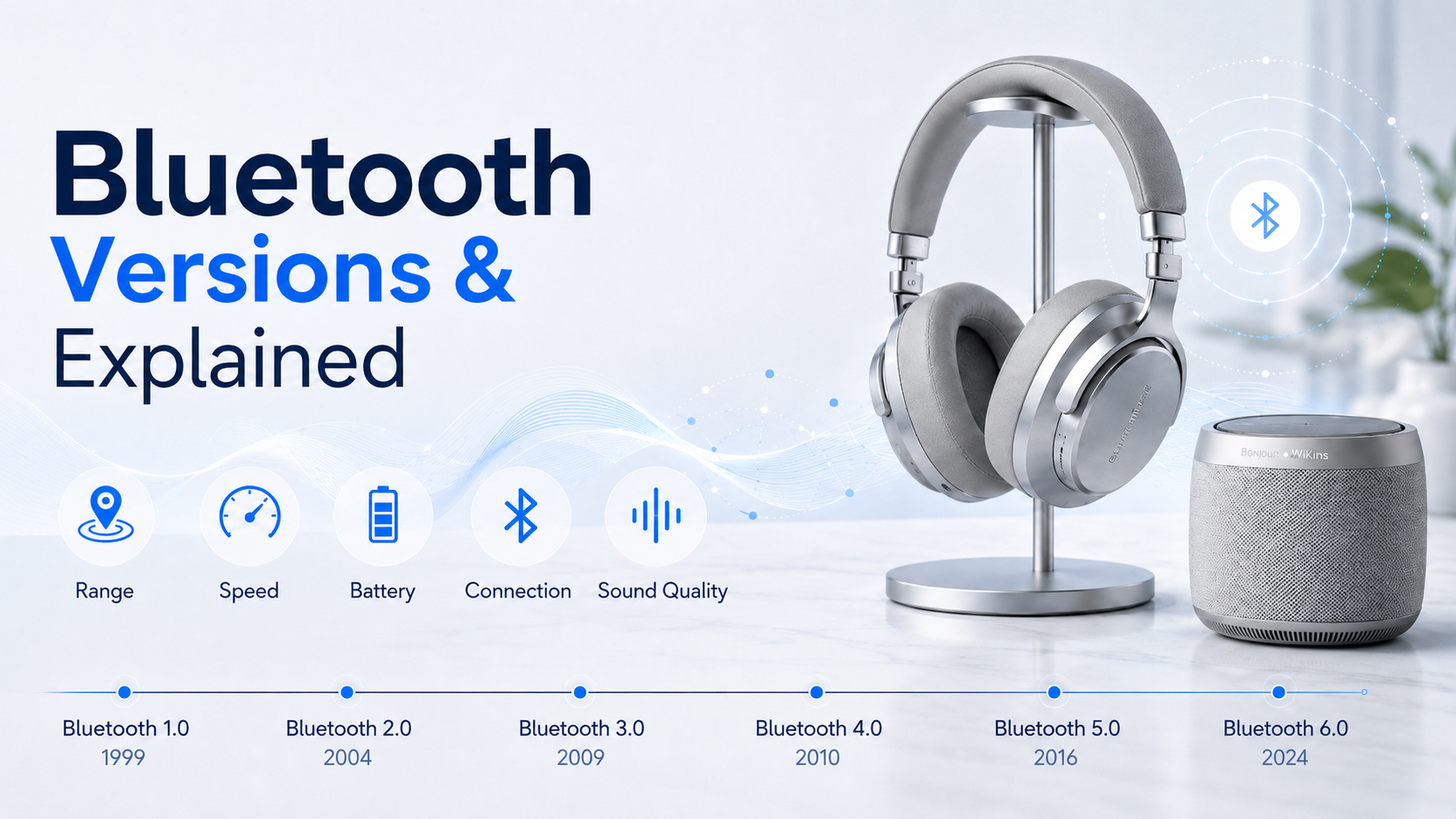
The first Bluetooth generations, from Bluetooth 1.0 through Bluetooth 3.0, were mainly created to replace cables between mobile phones, computers, headsets and simple audio devices. Bluetooth 1.0 and 1.1 established the basis for short range wireless links, while Bluetooth 1.2 improved reliability in the busy 2.4 GHz band. Bluetooth 2.0 plus EDR increased data rate and made wireless stereo audio more practical, after which Bluetooth 2.1 made pairing easier and more secure. Bluetooth 3.0 plus HS focused on higher transfer rates through an additional data link, but for music playback Bluetooth Classic with A2DP remained the key technology in most audio products.
With Bluetooth 4.0, Bluetooth Low Energy, often called Bluetooth LE, arrived alongside Bluetooth Classic. It did not replace the existing audio foundation, but added a very efficient radio layer for small devices, sensors, remote controls, wearables and later also modern audio features. Bluetooth 5.0 gave Bluetooth LE more possibilities around speed, range and advertising data, while Bluetooth 5.1 added direction finding for more precise positioning. Bluetooth 5.2 is especially relevant for music lovers because it created the foundation for LE Audio, LC3 and synchronized audio streams. Bluetooth 5.3 improved connection efficiency, while Bluetooth 5.4 added functions such as Periodic Advertising with Responses and encrypted advertising data, mainly useful for smart labels, retail systems and connected devices.
Bluetooth 6.0, 6.1, 6.2 and 6.3 show clearly that Bluetooth is developing not only for music, but also for location, safety, responsiveness and efficient radio use. Bluetooth 6.0 introduced Channel Sounding, a technology that allows two devices to estimate distance more accurately than by signal strength alone, which is useful for digital keys, find my solutions and smart access systems. Bluetooth 6.1 introduced Randomized RPA Updates, allowing devices to change their private address at less predictable moments, making tracking more difficult. Bluetooth 6.2 reduced the minimum connection interval to 375 microseconds for faster interaction and added protection against certain attacks on Channel Sounding. Bluetooth 6.3 further refines Channel Sounding, expands HCI capacity and better aligns radio requirements.
When choosing wireless headphones, a Bluetooth receiver or active speakers, customers often encounter terms such as Classic Audio, LE Audio, A2DP, AVRCP and HFP. Classic Audio uses the Bluetooth Classic radio and remains the basis for many current headphones, speakers and receivers. A2DP is the profile used for stereo music transmission, AVRCP is important for controls such as play, pause and track skipping, while HFP is mainly used for calls with a microphone. LE Audio operates through Bluetooth LE and is designed as a modern audio layer with new capabilities such as LC3, Multi Stream Audio and Auracast. Auracast allows one audio source to broadcast one or more audio streams to an unlimited number of compatible receiving devices, for example in a living room, gym, airport or public venue.
Codecs also need a clear explanation because they largely determine how the audio signal is packed for Bluetooth transmission. SBC is the basic codec understood by almost every Bluetooth audio device. AAC is widely used by mobile devices and can sound excellent when implemented well. aptX, aptX HD, aptX Adaptive and aptX Lossless are Qualcomm technologies where the actual result depends on support in both the sending and receiving device. LDAC was developed by Sony and can use up to 990 kbps on suitable devices. LC3 belongs to LE Audio and is designed to provide good quality at lower data rates, giving manufacturers more freedom to balance sound quality, battery life and product size. The most important buying advice is simple. A codec only works when both devices support it and when the connection is stable enough.
Finally, there are terms that often appear on packaging but are not always explained. Pairing means that two devices recognize each other and receive permission to connect. Multipoint means that headphones or speakers can stay connected to two sources at the same time, for example a laptop and a phone. Latency is the delay between picture and sound, something especially noticeable with films and gaming. Range is influenced by walls, furniture, antenna design and transmission power, not only by the Bluetooth version. PHY is the physical radio layer and describes how radio signals are sent. GATT, services and characteristics mainly belong to Bluetooth LE applications and describe how data is read and written between devices. Understanding these terms makes it much easier to choose a Bluetooth product that truly fits your system.


