
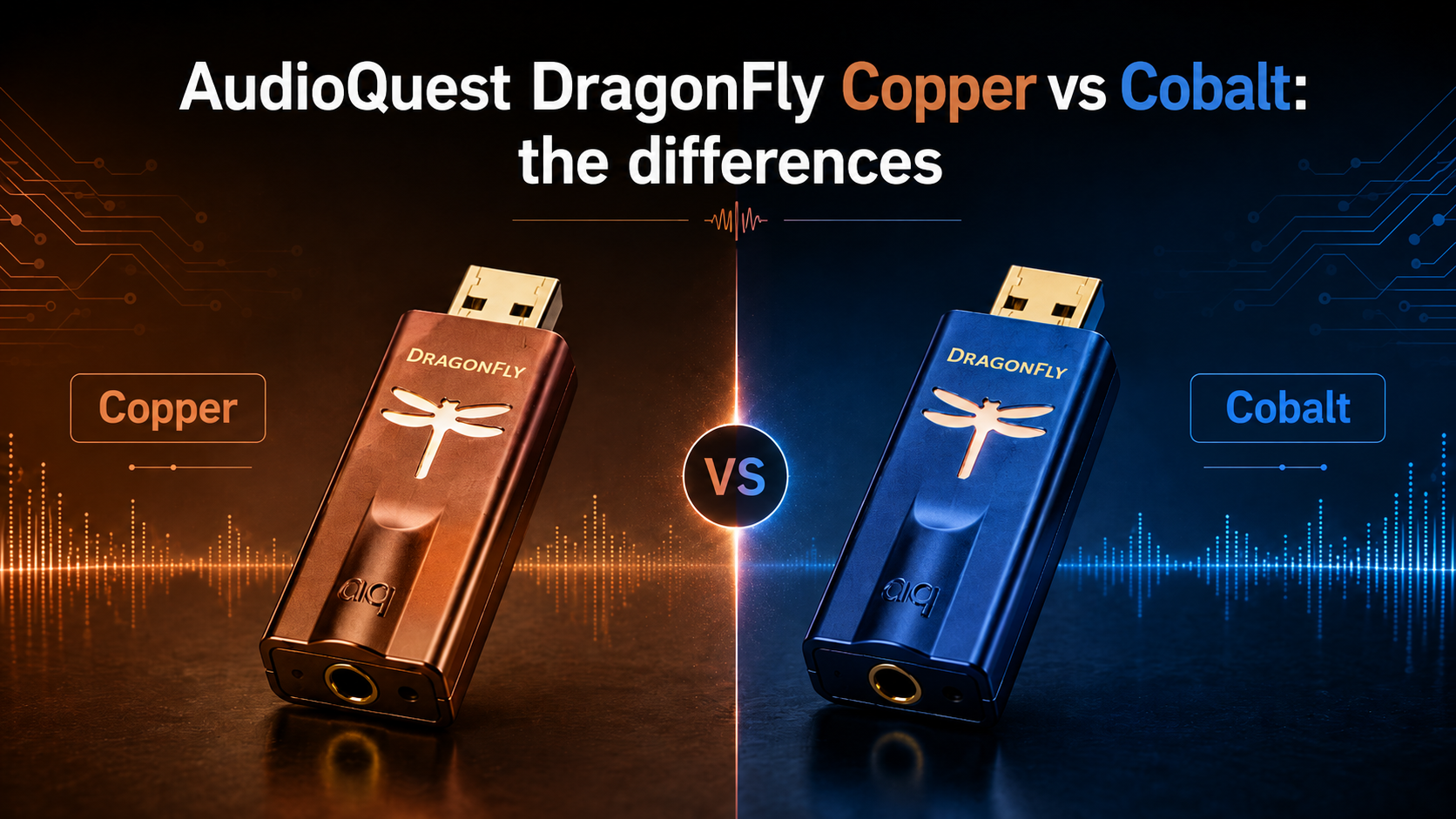
AudioQuest DragonFly Copper vs Cobalt: Key Differences
The arrival of AudioQuest DragonFly Copper marks an important technical update to one of the best-known compact USB DAC families.
DragonFly Cobalt had occupied the top position in the range since 2019, but Copper is much more than a cosmetic variation.
Both devices combine a USB DAC, preamplifier and headphone amplifier in a pocket-sized enclosure. Both process audio natively at up to 24-bit/96 kHz and can be used with computers, smartphones, tablets, headphones, powered speakers and complete audio systems.
Internally, however, they are considerably different.
DragonFly Copper vs Cobalt at a glance
| Feature | DragonFly Copper | DragonFly Cobalt |
| DAC | ESS Sabre ES9218 | ESS ES9038Q2M |
| Headphone amplifier | Integrated into ES9218 | ESS Sabre 9601 |
| Native resolution | Up to 24-bit/96 kHz | Up to 24-bit/96 kHz |
| Output | 2x greater power than any previous DragonFly according to AudioQuest | 2.1 V |
| Volume control | 64-bit bit-perfect digital | 64-bit bit-perfect digital |
| MQA rendering | No | Yes |
| Main connector | USB-A | USB-A |
| USB-C | Included DragonTail adaptor | Included DragonTail adaptor |
| Noise management | Copper-plated RF-draining enclosure | Internal power-supply filtering |
| Introduced | 2026 | 2019 |
A different DAC architecture
DragonFly Cobalt uses the ESS ES9038Q2M DAC together with the ESS Sabre 9601 headphone amplifier.
For Copper, AudioQuest switched to the ESS Sabre ES9218, an integrated DAC and headphone amplifier solution.
According to DragonFly designer Gordon Rankin, one of the most frequent requests from customers was additional headphone power. The ES9218 provided the basis for a redesigned DragonFly capable of delivering substantially more power.
Copper delivers more headphone power
AudioQuest states that DragonFly Copper delivers twice the output power of any previous DragonFly.
Cobalt's 2.1-volt output already makes it compatible with a broad selection of headphones. Copper expands the available power reserve, which can be particularly useful with less efficient headphones.
More power does not automatically mean better sound with every headphone, but it does give Copper greater flexibility.
Both support native 24-bit/96 kHz
Copper does not increase the maximum native sample rate.
Both models support audio at up to:
24-bit/96 kHz
with 44.1, 48, 88.2 and 96 kHz sample rates.
The real improvements therefore concern the internal architecture, amplification, efficiency, noise management and distortion rather than headline resolution numbers.
MQA: Cobalt yes, Copper no
DragonFly Cobalt includes MQA rendering.
DragonFly Copper does not.
Removing the MQA requirement was part of Copper's redesign. According to Gordon Rankin, MQA processing required additional DSP resources and therefore more processing power and energy. Removing that requirement allowed AudioQuest to select a less power-hungry processor and rethink other parts of the design.
For TIDAL users, MQA support is considerably less important today because TIDAL removed MQA content from its service in July 2024 and uses FLAC for stereo high-resolution music.
Owners of a local MQA collection may still value Cobalt's rendering capability.
Lower current draw
Copper draws approximately 25% less current than previous DragonFly designs, according to AudioQuest.
Because DragonFly receives its power over USB from the connected source, this is particularly relevant when using a smartphone, tablet or laptop.
Copper therefore combines lower energy consumption with substantially higher headphone output power.
Different approaches to noise reduction
Cobalt includes power-supply filtering designed to reduce interference associated with Wi-Fi, Bluetooth and cellular signals.
Copper takes a different approach in addition to its redesigned electronics: its enclosure is plated with highly conductive copper.
AudioQuest says this material helps drain induced radio-frequency energy away from the circuitry.
The Copper name is therefore not simply a styling decision; the case itself is part of the RF-noise management strategy.
What about sound quality?
Sound quality comparisons need to be treated carefully unless both products have been evaluated under identical conditions.
Technically, Copper has several advantages that could influence performance, including increased power, lower current consumption, revised circuitry, an integrated ESS DAC/headphone amplifier and improved RF-noise drainage.
AudioQuest's own engineering team describes Copper compared with Cobalt as providing more gain, stronger low-frequency grip, greater microdynamic expression and more resolution.
Cobalt nevertheless remains a highly capable design with its ES9038Q2M DAC, minimum-phase slow-roll-off filter, ESS 9601 headphone amplifier and 2.1-volt output.
Copper should therefore be regarded as a new technical generation rather than simply a differently finished Cobalt.
Should Cobalt owners upgrade to Copper?
An upgrade makes most sense when you:
- need additional headphone power;
- frequently use DragonFly with a phone or tablet;
- want lower power consumption;
- want the latest DragonFly architecture;
- value improved RF-noise drainage;
- no longer require MQA rendering.
If Cobalt already drives your headphones comfortably and you are completely satisfied with its performance, there is no requirement to replace it.
Which DragonFly should you choose today?
For most new buyers, DragonFly Copper is the more logical choice.
It represents AudioQuest's latest generation, provides more headphone power, consumes less energy and uses a substantially redesigned architecture.
Cobalt can still make sense for listeners who specifically want its ES9038Q2M-based design or need MQA rendering for an existing music library.
For contemporary portable listening and modern streaming, Copper has the stronger technical proposition.
Conclusion
DragonFly Copper is not simply Cobalt with a copper finish.
Although both DACs share native 24-bit/96 kHz playback and the familiar compact DragonFly format, Copper changes the DAC/headphone architecture, increases available power, reduces current consumption and introduces a copper-plated enclosure for improved RF-noise drainage.
Cobalt remains a capable premium portable DAC, but Copper moves the DragonFly concept into a new generation.
Discover the AudioQuest DragonFly Copper at Hi-Stands for current specifications, pricing and availability.
You can also explore our complete range of DACs and digital-to-analogue converters for other ways to improve computer, mobile and hi-fi audio.
Frequently Asked Questions
Is DragonFly Copper better than Cobalt?
Copper is technically newer, with more output power, lower current consumption and a redesigned DAC/headphone architecture. Actual listening results also depend on headphones, source and personal preference.
What DAC chips do they use?
Copper uses the ESS Sabre ES9218. Cobalt uses the ESS ES9038Q2M DAC together with an ESS 9601 headphone amplifier.
Does Copper support 192 kHz?
No. Both models process audio natively at up to 24-bit/96 kHz.
Does DragonFly Copper support MQA?
No. Cobalt supports MQA rendering; Copper does not.
Is Copper more powerful than Cobalt?
Yes. AudioQuest states that Copper delivers twice the headphone output power of any previous DragonFly.


