
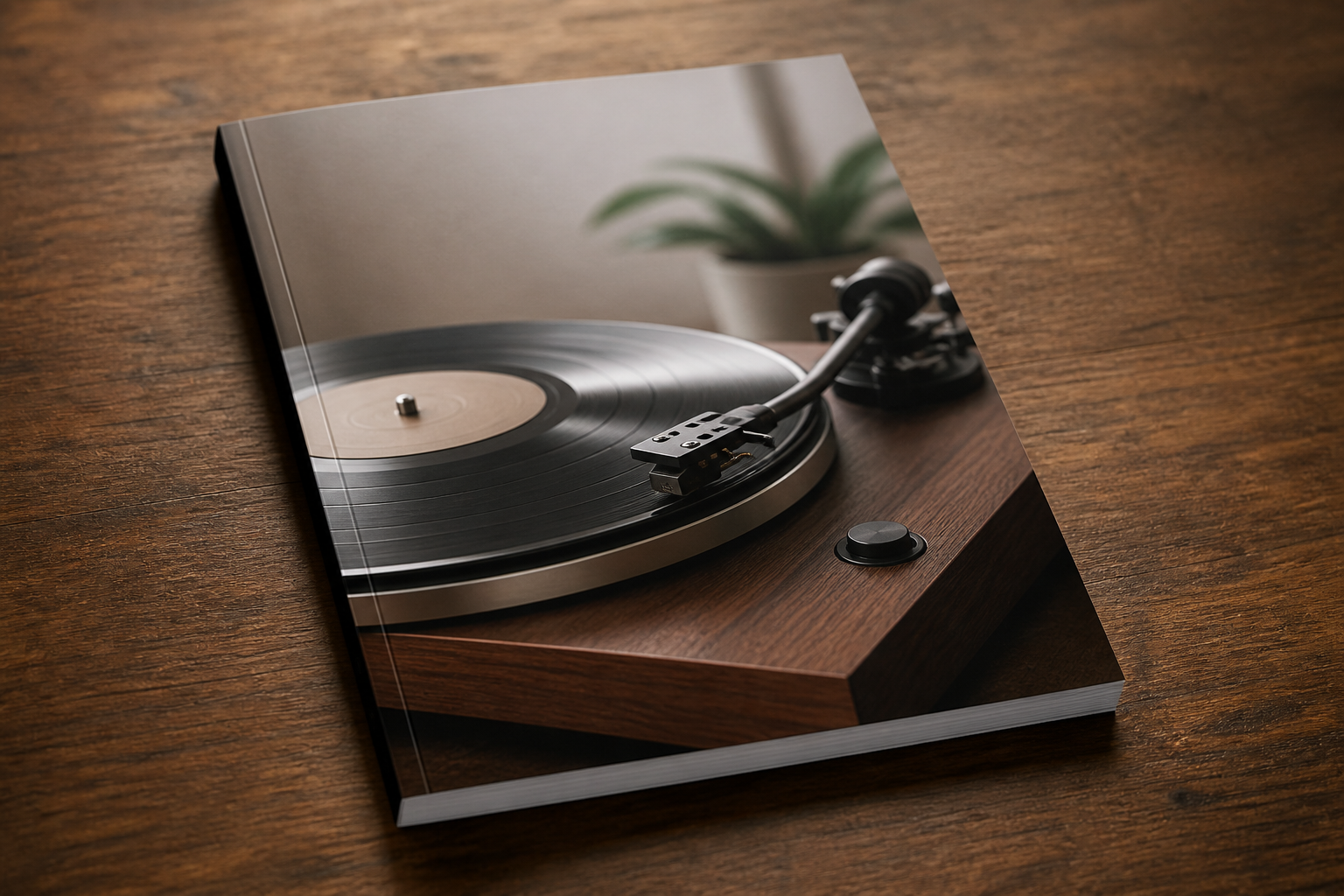
When getting started with vinyl, it quickly becomes clear that there is more involved than just a turntable. The real performance depends on how well the different components work together. Below you’ll find a clear and practical explanation of what you need and what to look out for.
The structure of a turntable
A turntable consists of three essential components that work together to generate the audio signal:
- Motor unit (drive system) – rotates the record
- Tonearm – guides the cartridge across the record
- Cartridge – converts movement into an electrical signal
Inside the cartridge is the stylus (needle), which traces the grooves of the record. It is the only part that physically touches the vinyl. Depending on the design, the stylus may be replaceable or fixed.
In higher-end systems, these components are often selected separately for maximum performance. In entry-level and mid-range setups, the motor unit and tonearm are usually combined, often with a pre-installed cartridge.
Why additional electronics are required
Unlike modern audio sources such as CD players or streamers, a turntable produces a very low-level signal. This signal is generated purely mechanically by the movement of the stylus in the groove.
The cartridge effectively acts as a tiny generator, converting motion into voltage. However, this voltage is extremely small and must be amplified before it can be used by an amplifier or speakers.
Additionally, records are produced using a specific equalisation curve:
- Bass frequencies are reduced
- Treble frequencies are boosted
This is done to optimise space and reduce noise. During playback, this process must be precisely reversed.
The role of the phono preamp
This is where the phono preamp (phonostage) becomes essential. It performs two key functions:
- Amplifies the very low signal
- Applies RIAA equalisation
The RIAA standard is used worldwide and ensures that music is reproduced as intended. Without this correction, vinyl would sound thin and overly bright.
Choosing between MM and MC cartridges
There are two main types of cartridges:
- Moving Magnet (MM)
Reliable, widely used, and often equipped with a replaceable stylus. Suitable for most applications. - Moving Coil (MC)
More refined in design and often capable of greater detail. However, they produce a much lower output signal.
MC cartridges typically output around ten times less signal than MM cartridges, meaning the phono preamp must provide more gain.
In some cases, a step-up transformer is used to raise an MC signal to MM level. This can deliver exceptional sound quality, but is a more specialised and costly solution.
The complete playback chain
A typical vinyl playback system consists of:
- Turntable (with tonearm and cartridge)
- Phono preamp
- Amplifier
- Speakers
Older amplifiers often include a built-in phono stage (phono input). Modern amplifiers usually do not, making an external phono preamp necessary.
An external phonostage connects easily to a standard line-level input such as AUX or CD.
Modern alternatives
There are also more compact and user-friendly solutions available today:
- Active speakers (with built-in amplifier)
- Turntables with integrated phono preamps
These options reduce the number of components but may involve compromises in sound quality.
Conclusion
To play vinyl properly, you need:
- A turntable (motor unit and tonearm)
- A suitable cartridge
- A phono preamp
- An amplifier and speakers
The key factor is proper matching between the cartridge and the phono preamp, as this has a major impact on overall sound quality.