
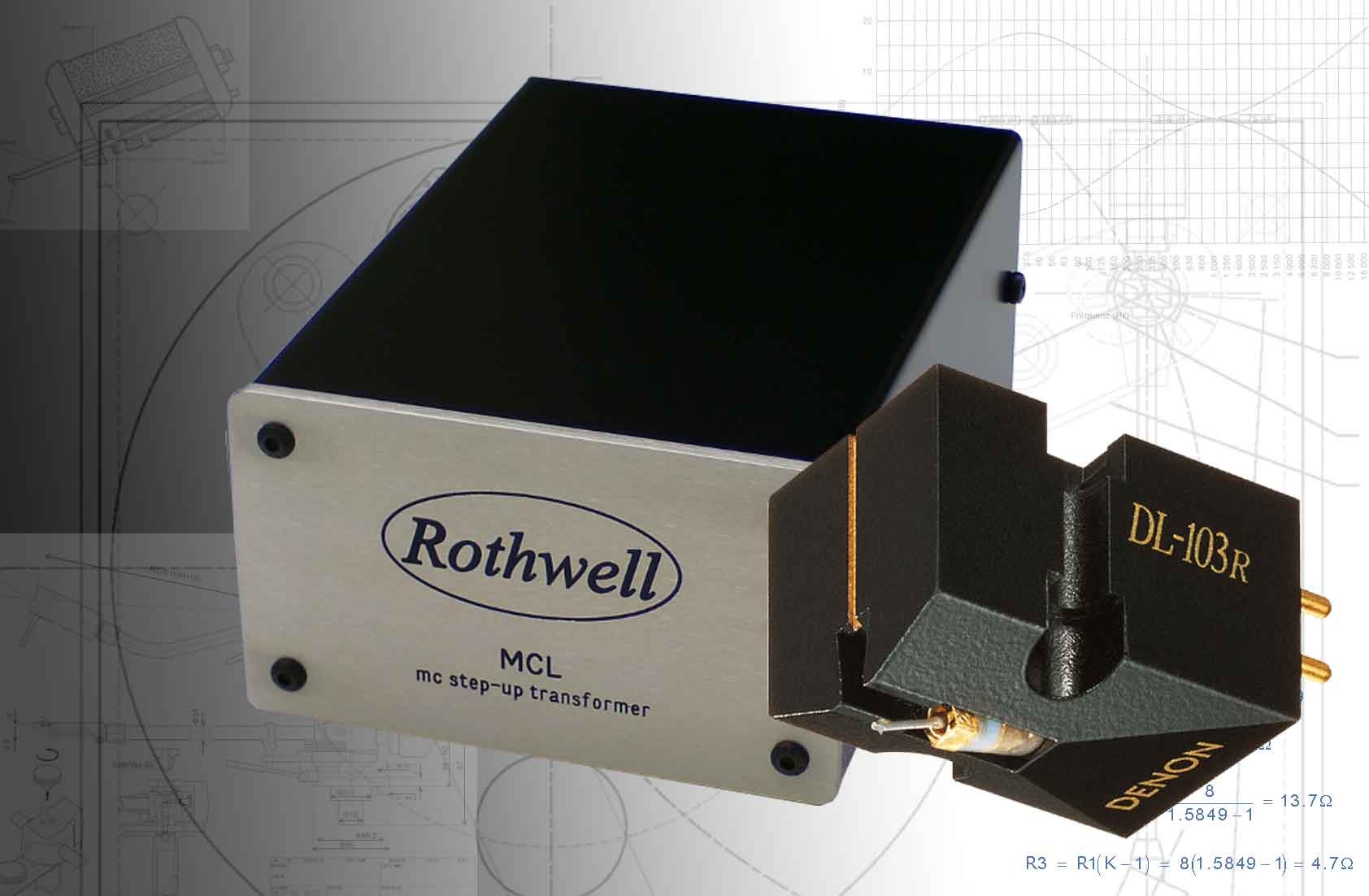
Denon moving coil cartridges are very popular, and discerning listeners who want to extract the best possible performance from them often turn to step-up transformers in their pursuit of ultimate sound quality. However, some Denon cartridges are not so easy to match with a transformer due to their higher-than-average source impedance and lower-than-average output voltage. So what is the correct transformer ratio? That depends to some extent on the specific cartridge, but calculations show that there is a “one size fits all” solution for low output moving coils with surprisingly little compromise.
DL-304
This cartridge has a source impedance of 40 ohms but a very low output voltage of only 0.18 mV. Attempting to achieve a signal voltage of 5 mV into the following MM phono stage might suggest a transformer ratio of 1:28. However, with such a ratio, the cartridge would see a load impedance of only 60 ohms when connected to a standard 47k MM input—too low for a cartridge with a 40-ohm source impedance. There would be a signal loss of approximately 4.5 dB at the cartridge/transformer interface, resulting in an output voltage of only 3 mV rather than 5 mV.
While 3 mV is sufficient for most MM phono stages, the signal-to-noise ratio will be lower than if a higher signal level were available. Increasing the ratio to 1:40 does not improve matters: the load impedance drops further to just 29 ohms, and the output voltage remains around 3 mV. Additionally, performance is likely to worsen, as higher ratios introduce technical drawbacks such as increased capacitance and resistance (affecting high frequencies) or reduced inductance (affecting low frequencies).
For this reason, it is good practice to keep the transformer ratio as low as possible. Theoretically, 1:35 would be optimal (yielding 24.68 dB of gain), but in practice, a lower ratio performs better. By sacrificing just 1 dB of gain, a ratio of 1:21 is sufficient, and 1:20 is a common and excellent practical choice.
Conclusion:
A ratio of 1:20 is highly suitable for the DL-304, delivering approximately 2.7 mV.
A ratio of 1:35 would provide 3.08 mV but with reduced bandwidth.
A suitable transformer is the Rothwell MCL.
DL-103
With an output voltage of 0.3 mV, this cartridge delivers more output than the DL-304 but has the same source impedance (40 ohms).
Theoretical optimum: 1:35 → 5.1 mV
Practical optimum: 1:20 → 4.5 mV with better overall performance
Conclusion:
Again, 1:20 is the best practical choice.
Suitable: Rothwell MCL.
DL-103R
This cartridge is a revised version of the DL-103 with a slightly lower output voltage (0.25 mV) but a significantly lower source impedance (14 ohms).
Theoretical optimum: 1:60—however, this is impractical and would result in an output voltage of approximately 15 mV, risking overload.
A better approach is to aim for around 5 mV:
- 1:24 → approximately 5 mV
- 1:20 → approximately 4.5 mV (only 1 dB difference)
Conclusion:
A ratio between 1:20 and 1:24 is ideal.
Suitable: Rothwell MCL.
DL-301mkII
Source impedance: 33 ohms
Output voltage: 0.4 mV
Theoretical optimum: 1:40 → 7.5 mV (too high and impractical)
Alternatives:
- 1:14 → 4.9 mV
- 1:10 → 3.7 mV
- 1:20 → 6.2 mV
Conclusion:
A ratio between 1:10 and 1:20 is recommended.
Suitable options include:
DL-110
This is a high output moving coil cartridge and is normally connected directly to an MM phono stage.
Source impedance: 160 ohms
Output voltage: 1.6 mV
A transformer can still provide benefits, provided the ratio is low:
- 1:3 → approximately 4.7 mV, resulting in a worthwhile improvement in signal-to-noise ratio
Conclusion:
A low ratio is essential.
Suitable: Rothwell MC1-H
However, many users operate the DL-110 directly without a transformer.
Alternative: Headamp
Instead of a step-up transformer, a headamp can be used. A headamp performs the same function but uses active amplification instead of transformers.
Advantages:
- Gain and load impedance can be adjusted independently
- Very wide bandwidth
Transformers, however, often still offer the lowest possible noise.
A suitable solution is the Rothwell Headspace, featuring multiple gain and load settings and compatibility with the full range of Denon cartridges.